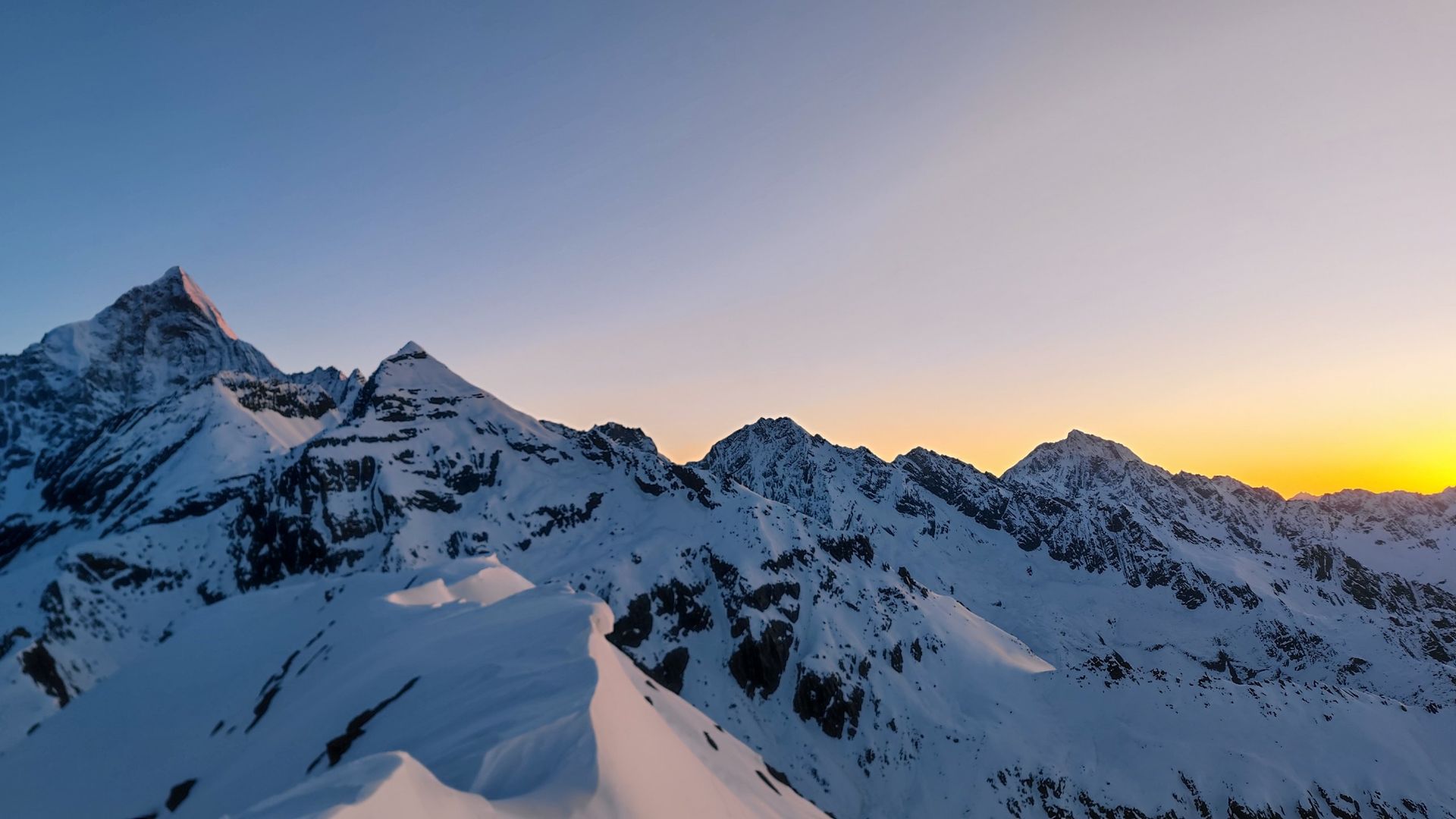
Climb a real 5,000m+ summit. In three days.
A pre-dawn start and a genuine 5,000m+ summit. Dafeng (5,025m) or Erfeng (5,276m) on Mount Siguniang, the Four Sisters Mountain, is one of China's classic entry-level ascents. No prior mountaineering experience required. Just a fit body, strong legs for two long days, and the will to leave camp in the middle of the night for it.
Four peaks. Two summits to choose from.
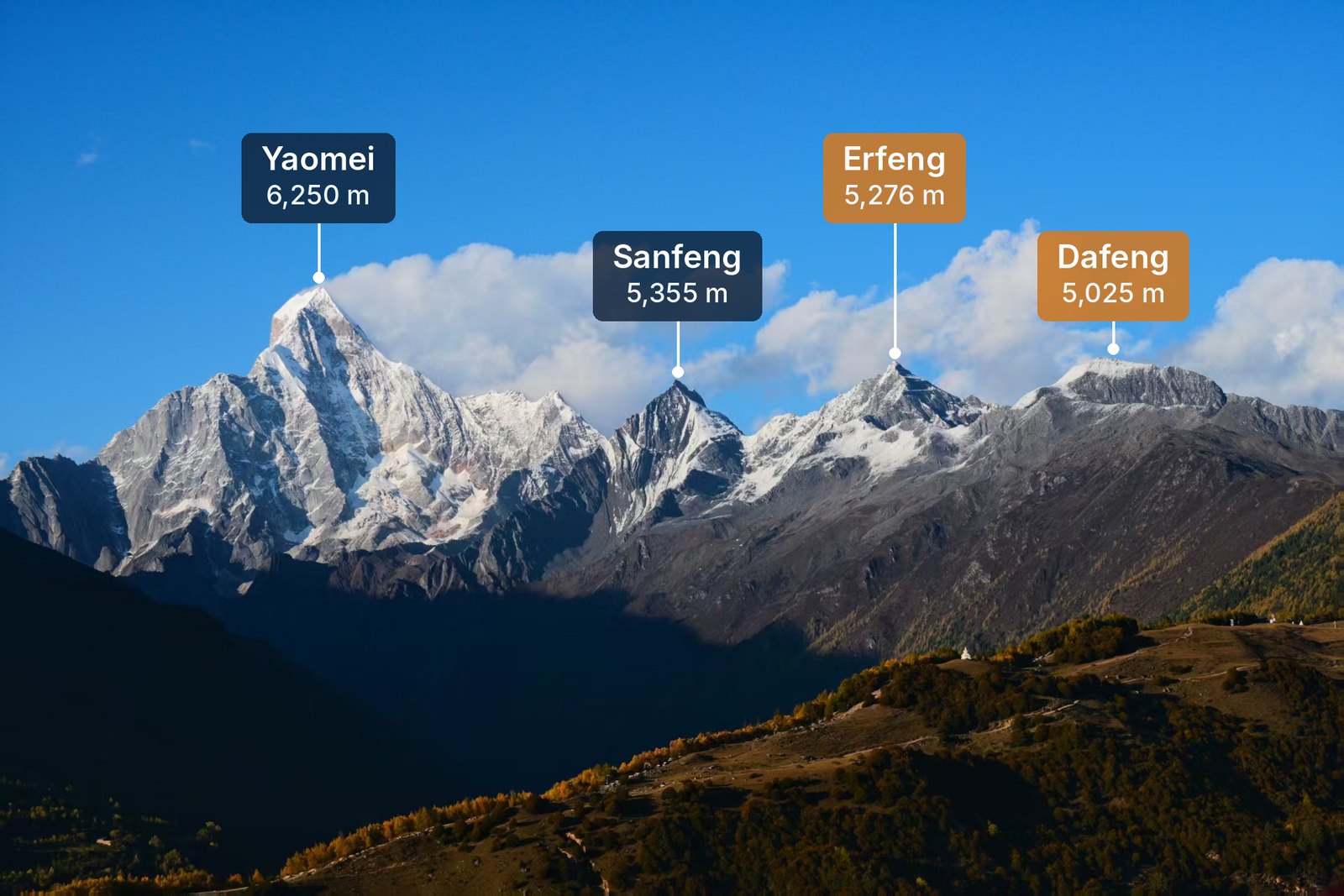
The massif is known in Chinese as the Four Sisters (四姑娘山). From north to south, Dafeng is the eldest sister, Erfeng the second, Sanfeng the third and Yaomei the youngest, even though she is the tallest of the four. Yaomei is also celebrated as the mother of all the mountains of Sichuan, the "Queen of the Sichuan mountains" (蜀山之后), with Minya Konka as the father, the "King of the Sichuan mountains" (蜀山之王). This trip climbs Dafeng or Erfeng, shown in orange.
Sanfeng · 5,355 m
Sanfeng is also open to commercial groups, but only in July and August, and it requires the use of ropes. For that reason we do not offer it to non-Chinese-speaking guests.
Yaomei · 6,250 m
Yaomei was first climbed in 1981 by a Japanese team via the southeast ridge. A few strong teams have followed since, including the southwest ridge in 2008 and a new line on the south face in 2009 by Chinese climbers Yan Dongdong and Zhou Peng. It remains a serious technical objective for professional mountaineers only, and is completely out of reach of commercial expeditions.
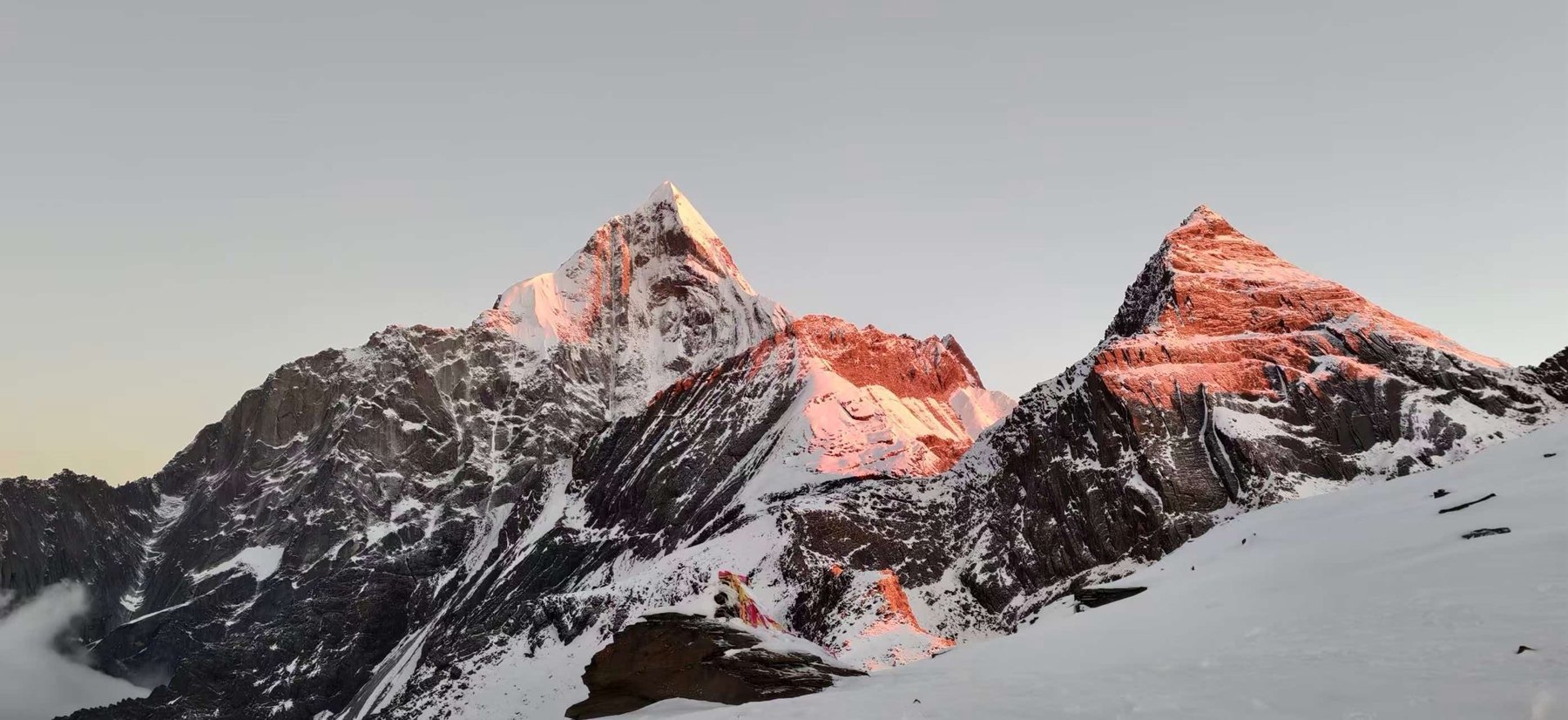
The narrow, useful middle ground of mountaineering.
Most "beginner mountaineering" trips in China fall into one of two camps: easy guided walk-ups, or multi-week expeditions that quietly assume you've already climbed a 5,000m peak. Siguniang sits in the gap between them. You reach a real 5,000m+ summit in three days from Chengdu, short enough and supported enough that a reasonably fit first-timer can do it in a long weekend, with a personal guide beside you for the summit push.
Mount Siguniang is the highest massif of the Qionglai Mountains, nicknamed the "Oriental Alps". Its tallest peak, Yaomei, is 6,250m and is the easternmost 6,000m peak on Earth.
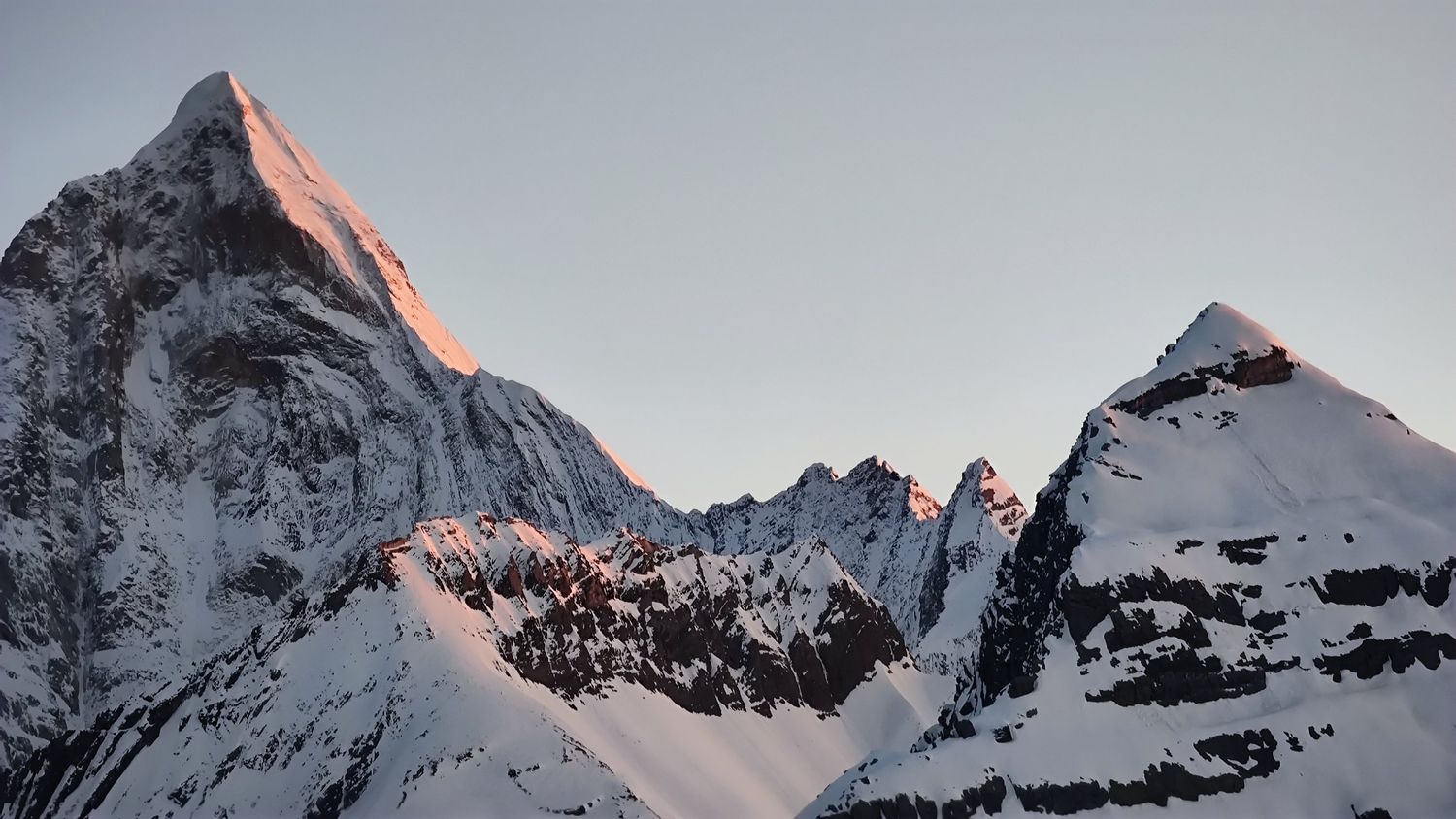
Three days, told straight.
No padding, no filler activities. Here's exactly what happens each day, including the parts that are genuinely hard. You choose your peak when you book: Dafeng (大峰) or Erfeng (二峰).
Chengdu → Balang Mountain → Siguniang town
about 4h drive (220 km) · no hike
Meet at Tianhe Road metro station (天河路地铁站) in Chengdu at around 08:30. The drive west leaves the city on the Chengdu–Wenchuan expressway via Dujiangyan, then follows the 303 provincial road up the Wolong gorge, past the giant panda conservation and breeding base, and over Balang Mountain (4,532m), the "panda kingdom", with its high meadows. On the way you stop at Cat's Nose Ridge (猫鼻梁), one of the best viewpoints over the whole Siguniang massif, before reaching Siguniang town.
In the evening you check in at a local guesthouse (standard twin room, shared with a traveller of the same sex; a single room is available for an extra 80 RMB, paid on site). At 18:00, a pre-trip briefing in the guesthouse lobby, then dinner together.
- Long driving day: please be on time at the meeting point.
- It's much colder when you arrive. Put on warm clothes promptly to avoid catching a chill and to help you adapt to the altitude.
Siguniang town → Dajianbao → Base Camp
15–16 km hike
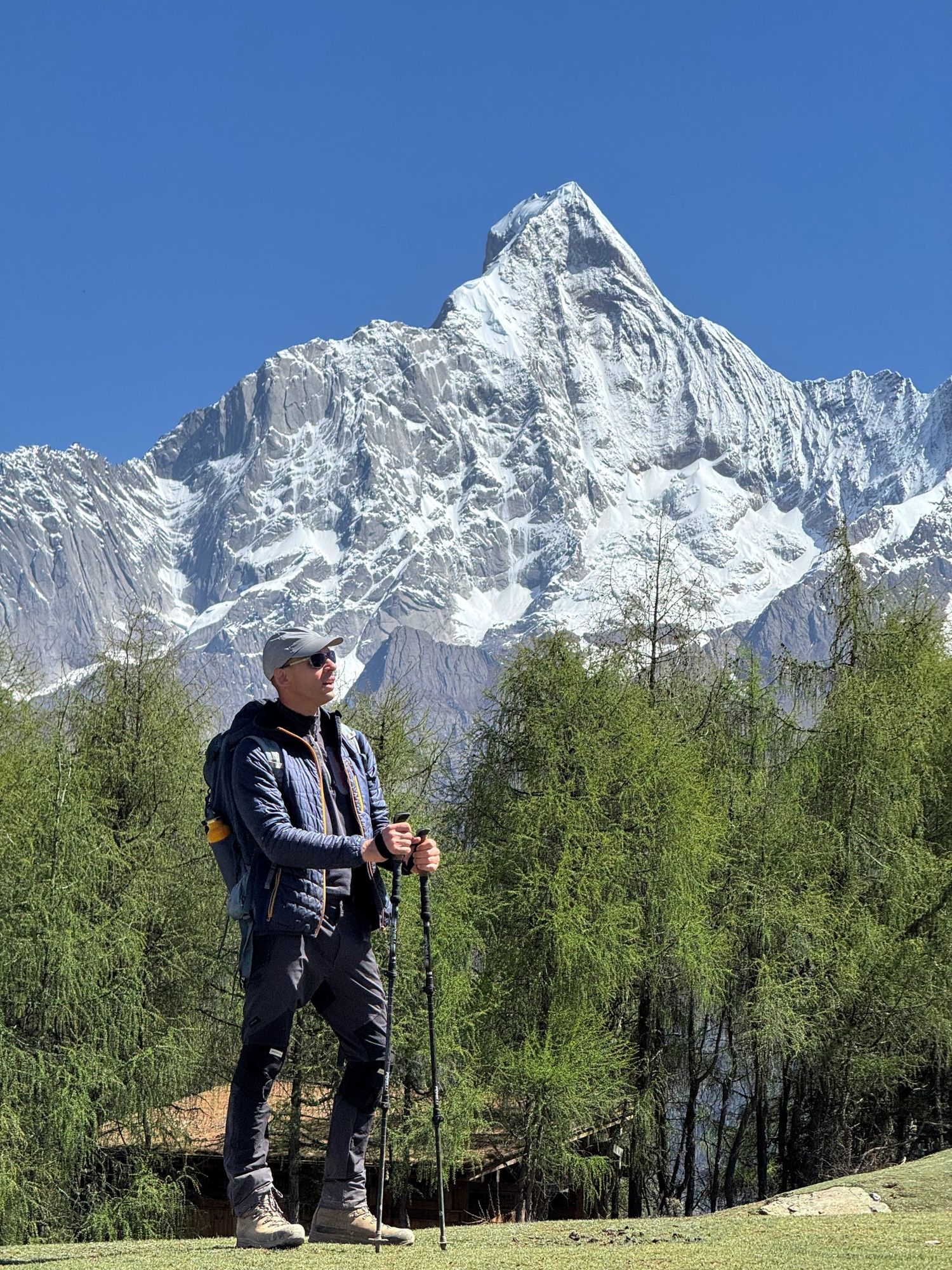
After breakfast, the hike begins. Today is the demanding one: about 15 to 16 km up the Haizi Valley (3,400m) to the Dajianbao ranger station (3,719m), where the trail splits. From there it's about 5.5 km to Dafeng Base Camp (~4,300m), or about 7 km to Erfeng Base Camp (~4,200m). You reach Dafeng Base Camp around 16:00, or Erfeng Base Camp around 17:00. Horses carry your main bag to camp, so you only carry a small daypack (about 30L) with trail food, rain gear and your layers. From town to Base Camp the group is led by 1 to 3 guides, depending on group size; your personal 1:1 guide takes over at Base Camp. You'll be climbing alongside other members of the same local climbing club; Base Camp is shared, not private.
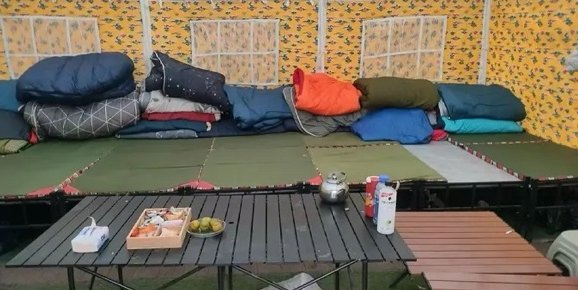
Base Camp is simple and high: tents, yurts and huts, in twin or multi-bed rooms. That evening: camp dinner, a safety briefing, an introduction to the guide who takes you to the summit, and an early night.
- Bring at least two trail lunches (Day 2 and summit day). Knee supports and trekking poles are recommended.
- Sleeping bags and mats are lent free of charge.
- Local food is Sichuan-Tibetan style, mostly hotpot-style pork and stir-fried dishes, prepared in full portions for the group. If you have food restrictions, bring your own.
- Hot water is available at camp, with limited supply in the evening.
Base Camp → Summit → Chengdu
about 6h (Dafeng) / 8h (Erfeng) summit round trip + walk down + about 4h drive
This is the long day. Wake-up is at 03:00, then breakfast, and you leave at 04:00 sharp, headlamp on. The round trip from Base Camp to the summit and back takes about 6 hours for Dafeng and about 8 hours for Erfeng, with your personal 1:1 guide beside you all the way. The hard summit cutoff is 09:00: later than that, you're turned back regardless of how close you are.
Most climbers in reasonable shape reach the top well before the cutoff, so there's no need to rush. Don't walk too fast: you risk reaching the summit in the middle of the night. Aiming to watch the sunrise from the top is not a good plan, since waiting in the cold is a bad idea. Walk slower and steadier instead. If the weather holds, this is the payoff: a view across the whole Siguniang massif, and your guide takes the photos so your hands stay free. A 200 RMB tip to your personal guide is customary on a successful summit.
Then the long way down: back at Base Camp you eat at your own pace, then walk down to Siguniang town, rest briefly and drive back to Chengdu (about 4 hours). Expect to reach Chengdu in the early evening, then celebrate with a free dinner in town.
- Vehicles leave as they fill up, so the exact return time can't be predicted. Book your onward train or flight for the next day.
- If you don't reach the summit because of time, weather or physical condition, the trip fee is not refunded.
- This is a group activity, and the plan can change for special reasons. Always follow your guide's instructions.
大峰 · 二峰 — Dafeng or Erfeng?
Dafeng (5,025m) is the more accessible of the two: a shorter summit day (about 6 hours round trip), usually treated as a trekking peak. Erfeng (5,276m) is higher and takes longer (about 8 hours round trip), with more demanding terrain that calls for basic climbing technique, which your guide shows you. Erfeng is also closer to Yaomei, so the scenery is even more impressive. Both follow the same three-day schedule, with the same 03:00 wake-up and 04:00 departure. Dafeng is sometimes open when Erfeng is not, depending on the amount of snow and on local regulations. The final choice is made in Siguniang town, and if you switch peaks, the price is adjusted accordingly (you pay more or get a refund). Doing both is possible but not that interesting: better to continue with another trek, or come to Mount Haba in Yunnan (get in touch). Not sure which to pick? Tell me your fitness and altitude experience and I'll tell you straight.
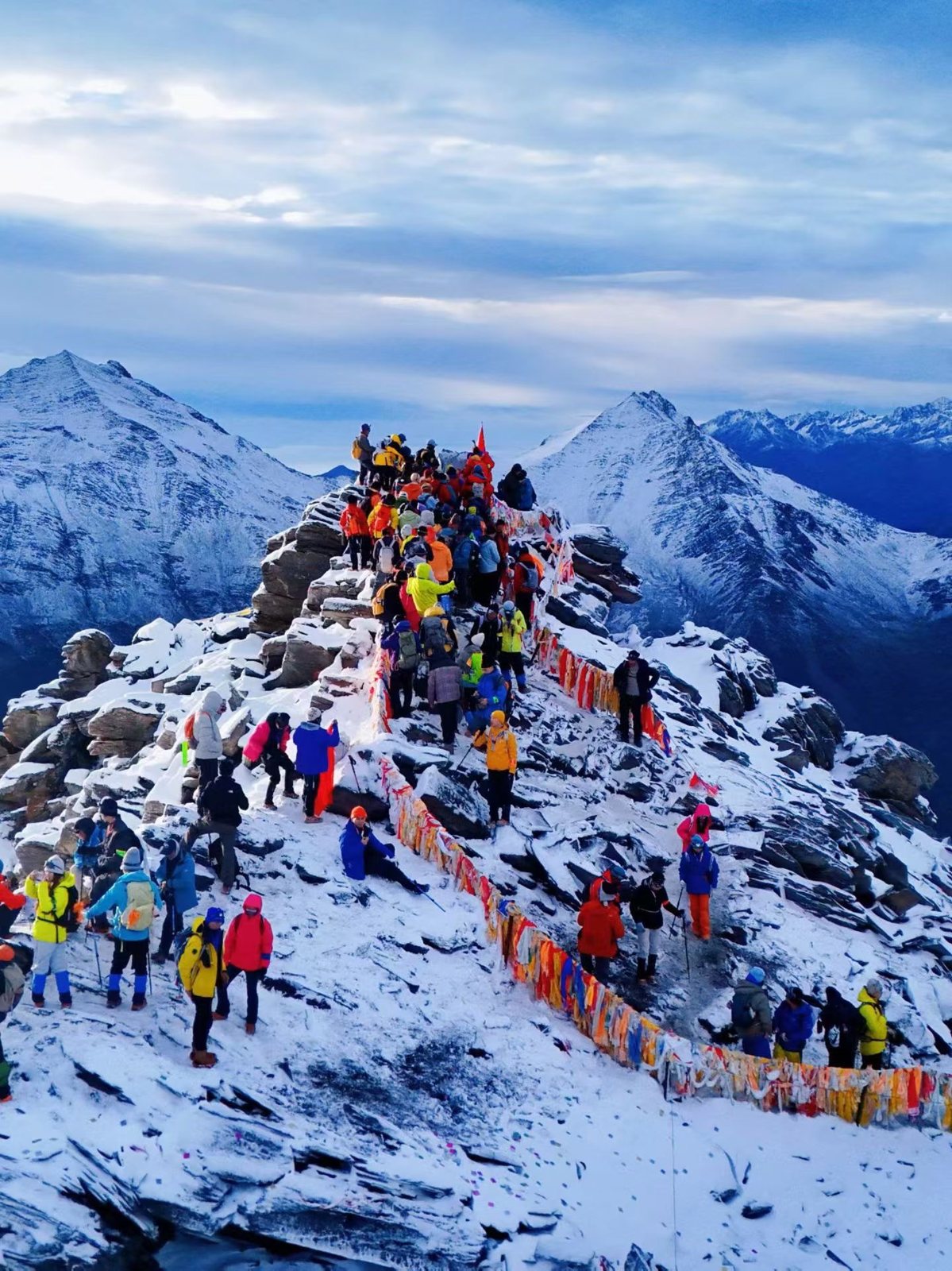
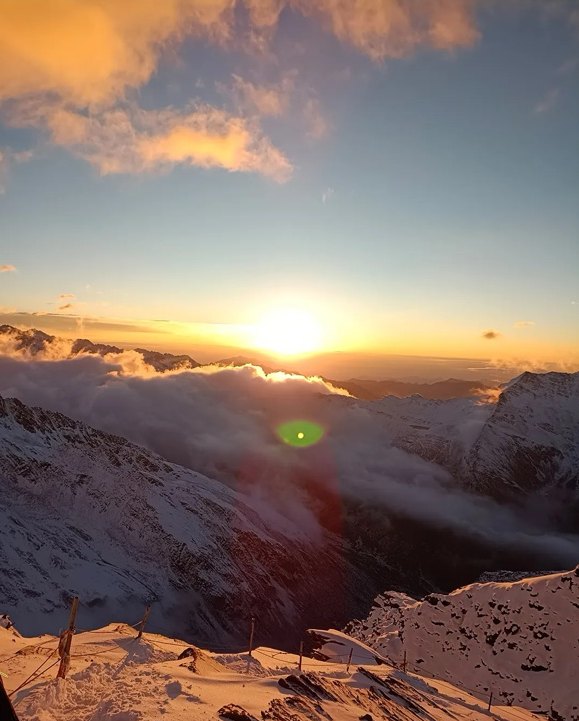
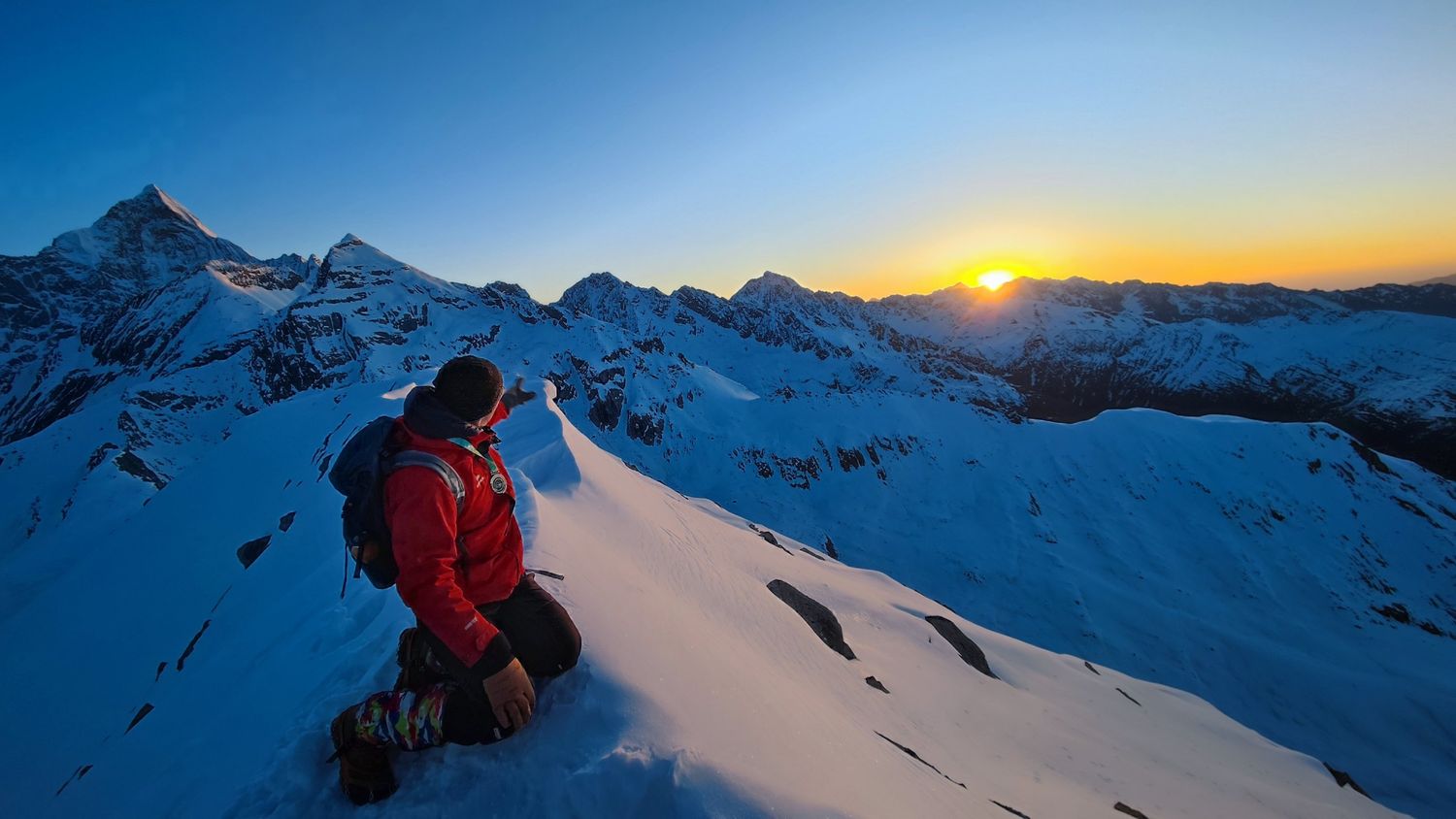
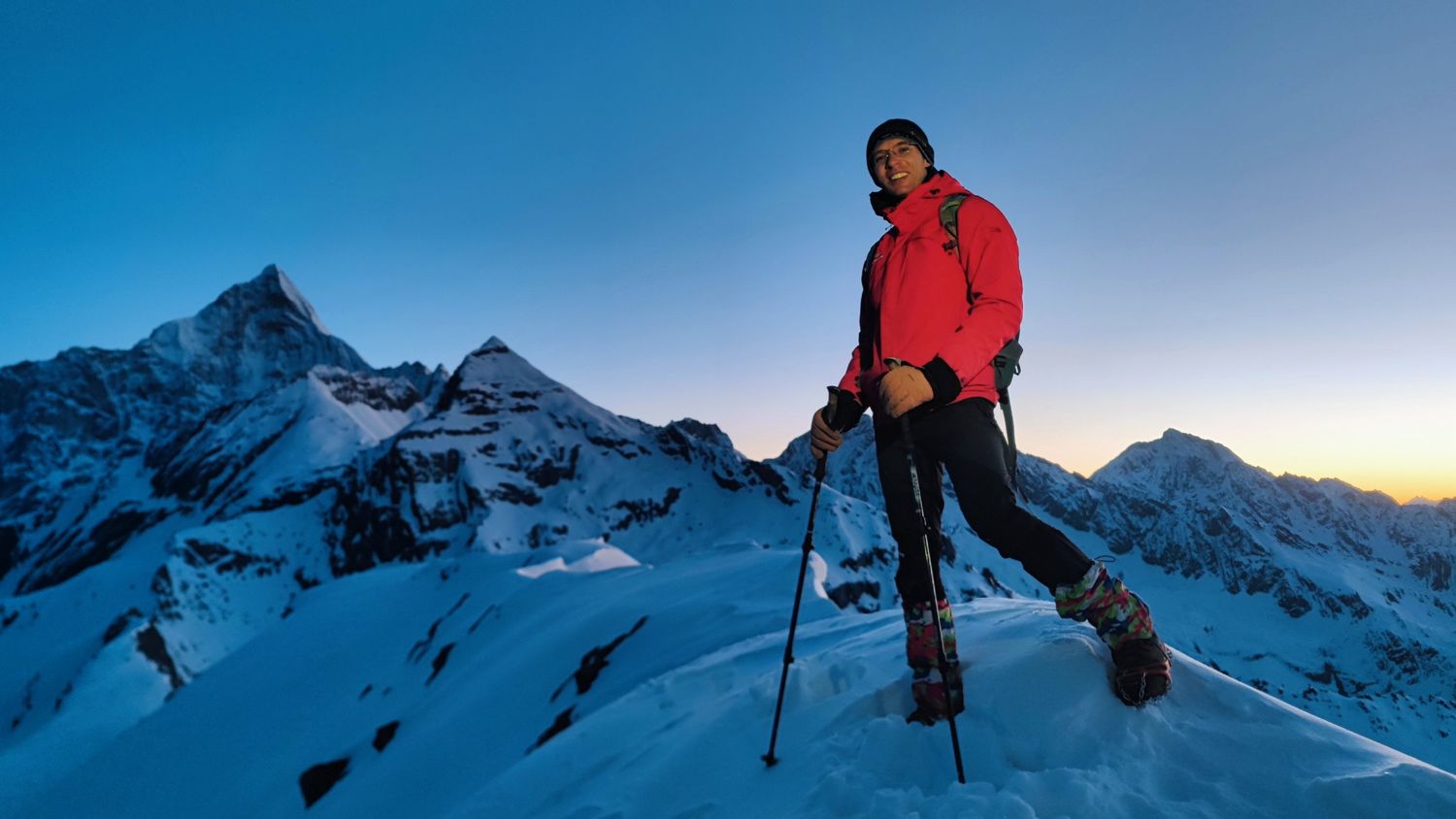 Panorama from the summit of Dafeng at dawn
Simple at the top, comfortable below.
A proper guesthouse room in Siguniang town, and an organized camp at 4,000m+. Here's what to expect.
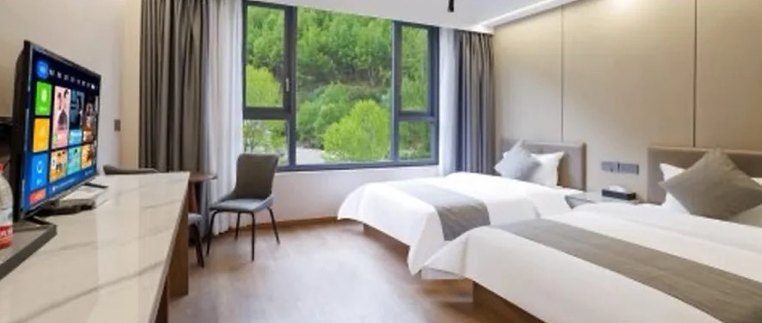
Siguniang town guesthouse
Night 1 is in a local guesthouse, in a standard twin room shared with a traveller of the same sex.
- Free Wi-Fi
- Shop and restaurant downstairs
- Free luggage storage while you're on the mountain
- Single room: 80 RMB supplement, paid on site
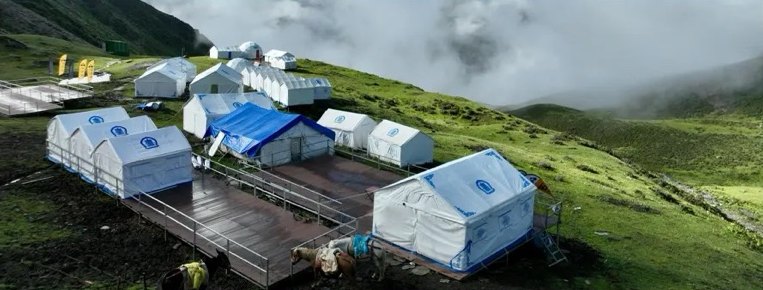
Base Camp
Tents, yurts and huts on the mountainside, in twin or multi-bed rooms.
- Free upgrade to a twin room at camp: please confirm with us before booking
- Sleeping bags and mats lent free of charge
- Hot water at camp, limited in the evening
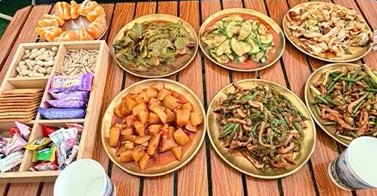
Food
In town, dinner is hotpot for groups of 4 or more, and stir-fried dishes for smaller groups. At camp, stir-fried dishes and an afternoon tea.
- Day 1 dinner, Day 2 breakfast and dinner, Day 3 breakfast included
- Lunches are not included: bring your own trail food
What you'll see along the way.
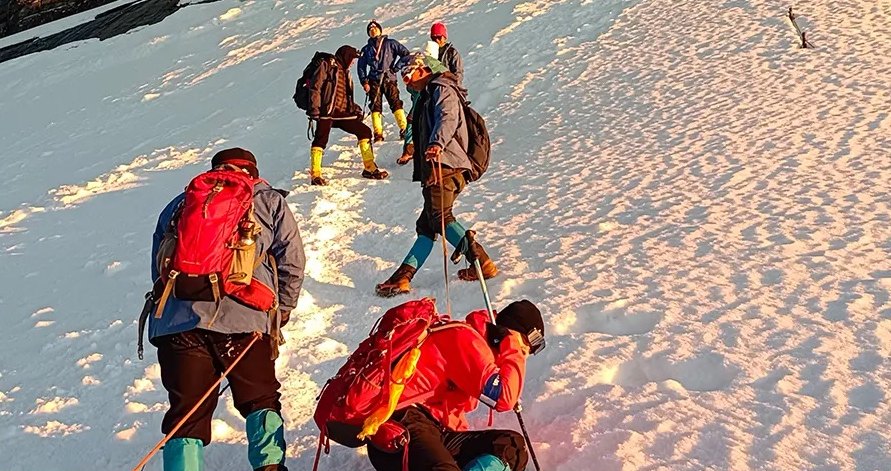
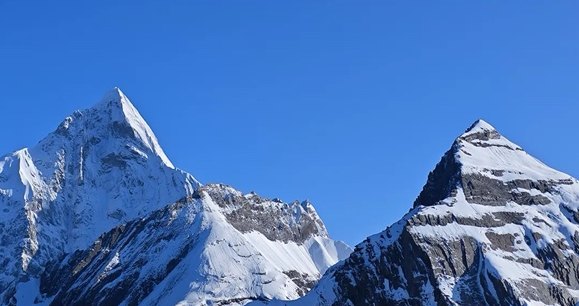
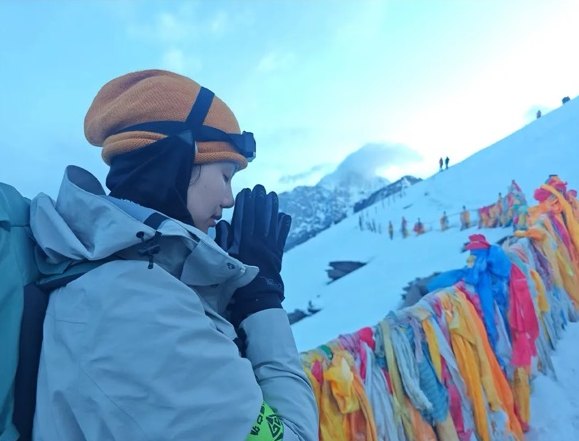
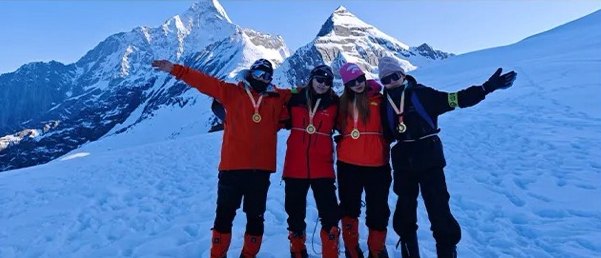
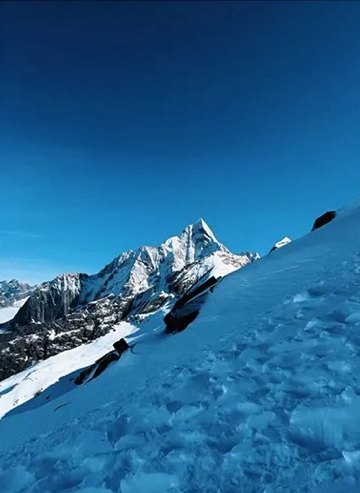
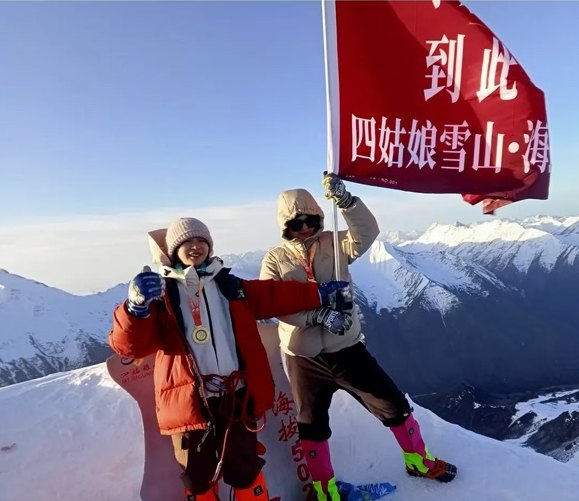
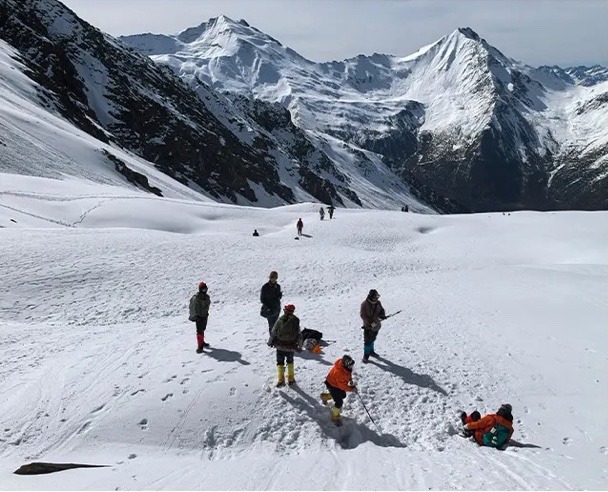
Photos from climbs on Siguniang, from the approach valley to the summit ridge.
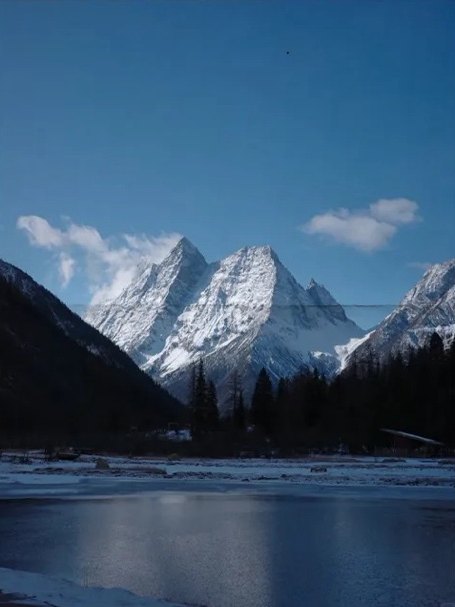
"Not everyone who starts Day 3 reaches the summit. That's the honest reality of mountain weather — not a flaw in the trip."
On the safety cutoffs, Day 3One price. No quote requests.
Per person, and it gets cheaper the more of you there are, but there's no minimum. You can book this solo.
| Group size | Dafeng · 5,025m | Erfeng · 5,276m |
|---|---|---|
| 1–2 people | ¥2,780 | ¥2,880 |
| 3–4 people | ¥2,580 | ¥2,680 |
| 5–6 people | ¥2,380 | ¥2,480 |
| 7+ people | ¥2,280 | ¥2,380 |
Included
- Transport, Chengdu ↔ Siguniang round trip (meeting at Tianhe Road metro station)
- Guesthouse night in Siguniang town: standard twin room (shared with a traveller of the same sex), free Wi-Fi, free luggage storage
- Meals: Day 1 dinner, Day 2 breakfast and dinner, Day 3 breakfast
- Insurance for the climb
- Base Camp accommodation, with sleeping bags and mats lent free of charge
- Horse to carry your main bag to Base Camp
- Park entrance ticket
- Guide-provided crampons, gaiters & headlamp
- Other equipment can be borrowed for free
- Safety briefing & English explanations throughout
- Guides leading the group on the approach, then a 1:1 personal guide from Base Camp, who also takes your photos
- A commemorative summit souvenir
Not included
- Lunches on all days, and dinner on Day 3: bring at least two trail lunches and snacks
- 200 RMB customary guide tip, on successful summit
- Riding a horse up to Base Camp (Day 2) or down (Day 3) instead of walking: not part of our service, paid on site and at your own risk
- Single room on Night 1: 80 RMB supplement, paid on site
- High-top hiking boots (ankle support)
I'm a Frenchman living in China. I've been to Siguniang several times and I've climbed it myself, as a client, not as a guide. Every account on this page is from my own trips, and the photos come from my own trips and from the local club's climbs.
The trip itself is run by an established local climbing club: real mountain guides, real base camp infrastructure, the safety-cutoff discipline described here. Its guides are the club's own team, not subcontractors, so quality stays under control from start to finish. I'm not a guide myself. What I can tell you honestly is what these three days actually feel like, because I've done them.
I also run a France-based trekking agency organizing longer adventure treks across Yunnan, Sichuan, Tibet, Qinghai, Gansu and Inner Mongolia, with English- or French-speaking guides. Get in touch if Siguniang is the start of a bigger trip.
The safety margins aren't marketing copy.
-
09:00Hard summit cutoffLater than this, you're turned around regardless of how close you are.
-
1:1Personal guide per climberFrom Base Camp, introduced the evening before, not a stranger on summit morning. Up to Base Camp, 1 to 3 guides lead the group.
-
~4,300mYou sleep high before summit dayDay 2 is a dedicated approach day. The summit push starts from Base Camp, not from town. A stay to acclimatize before coming is strongly recommended: without it, altitude sickness is very common. Taking acetazolamide as a preventive can help a lot (medical advice strongly recommended). A simple road trip in western Sichuan with one night at 4,000m in the days before also helps.
Two classic first 5,000m peaks. Which one?
Both are three-day climbs. Here's how they differ, so you can pick the one that fits your trip, your fitness and your dates.
| Haba Snow Mountain (Yunnan) | Siguniang (Sichuan) | |
|---|---|---|
| Difficulty | Harder. About 1,300m of climbing on summit day, and a higher summit (5,396m). | Easier. A lower summit (5,025m Dafeng, 5,276m Erfeng) and a shorter summit day. |
| Snow | Snow-covered all year round. | Often just rocky in summer. Lots of snow in late winter and early spring. |
| Open season | Generally open all year. | Not possible in winter (too much snow). The exact closure dates are not known in advance and change from year to year. |
| Getting there | About 3 hours by road from Lijiang. Easy to slot into a Yunnan trip. | Close to Chengdu, about 4 hours by car. Simpler as part of a Sichuan trip. |
| Scenery and feel | The highest summit of its range: you stand above everything around you, with a plunging view down to the Yangtze and Jade Dragon Snow Mountain facing you. | You are lower than the surrounding mountains, but the landscape is more alpine and more snowy, with a splendid peak of more than 6,000m (Yaomei) in view. |
| Crowds | Very busy during China's national holidays, quieter the rest of the year. | Busier in general, and the Base Camp is much bigger. |
Heading to Yunnan instead? I run the same three-day climb on Haba Snow Mountain: habasnowmountain.com.
Before you book.
No technical climbing background is required for Dafeng, the more accessible of the two peaks. Erfeng is more demanding and calls for basic climbing technique, which your guide shows you on the day. For both you do need to be a genuinely fit hiker: comfortable with a long, steady uphill day (the Day 2 approach alone is 15 to 16 km with over 1,000m of climbing) and several hours at altitude. The guide provides the gear and shows you how to use it; you don't need to already know how.
Dafeng (5,025m) has the shorter summit day and is usually treated as a trekking peak. Erfeng (5,276m) is higher, takes longer (about 8 hours round trip against about 6) and has more demanding terrain, but it is closer to Yaomei, so the scenery is even more impressive. Sometimes Dafeng is open while Erfeng is not, because of the amount of snow and local regulations. The final choice is made in Siguniang town, and if you change peaks the price is adjusted (you pay more or you get a refund). If this is your first 5,000m summit, Dafeng is the natural choice. If you have walked at altitude before and want a harder day, choose Erfeng. Tell us your fitness and experience when you enquire and we will give you a straight answer.
Haba is harder (about 1,300m of climbing on summit day and a higher summit), snow-covered all year, generally open all year, and about 3 hours from Lijiang, so it fits a Yunnan trip. Siguniang is easier, often rocky rather than snowy in summer, impossible in winter because of too much snow, and close to Chengdu (about 4 hours by car), so it fits a Sichuan trip. Haba is the highest summit of its range, with a plunging view down to the Yangtze and Jade Dragon Snow Mountain opposite; at Siguniang you are lower than the surrounding peaks but the scenery is more alpine and snowier, with a splendid peak of more than 6,000m in view. Siguniang is busier in general with a much bigger Base Camp, while Haba is crowded mainly during China's national holidays.
Not in these three days. Each peak has its own Base Camp and its own summit day, so this trip is one or the other. Doing both is possible but not that interesting: it is better to continue with another trek, or to come to Mount Haba in Yunnan. Get in touch and we will advise.
Guides make the go/no-go call based on real-time conditions. The safety cutoffs exist so that a slow start or worsening weather gets caught early rather than turning into a rescue. Not everyone who starts Day 3 reaches the summit. That's the reality of mountain weather, not a flaw in the trip.
Yes. Chengdu is at about 500m, you sleep at 3,200m on the first night, at about 4,300m (Dafeng) or 4,200m (Erfeng) on the second, and the summits are above 5,000m. On Day 1 the road also crosses the 4,532m Balang Mountain pass, a first taste of altitude. Day 2 is a dedicated approach day for that reason. This three-day format has little built-in acclimatization, so a stay to acclimatize before you come is strongly recommended. Without pre-acclimatization, altitude sickness is very common. Taking acetazolamide as a preventive can help a lot (medical advice strongly recommended). A simple road trip in western Sichuan with one night at 4,000m in the days before the climb also helps greatly. Anyone with relevant health concerns should consult a doctor before booking.
No. A second night at high elevation is often when acute altitude sickness actually hits, so it's safer to descend the same day. If what you're after is a longer trip around Siguniang with several nights in the mountains and more time to acclimatize, get in touch: that can be arranged as a tailor-made trip for a group of hikers.
Yes. There's no minimum group size. Solo travelers are matched into the operator's guide system like any other group.
Day 2, the hike up to Base Camp, is done together with the group. On Day 3, summit day, you go at your own pace with your private guide, so your success isn't tied to the fitness or speed of anyone else in the group. If you're climbing with friends, you're welcome to stay together, each with your own guide.
It depends mostly on fitness, acclimatization and weather. In good weather, well-prepared climbers have a good chance of reaching the top. In extreme conditions, such as strong winds, heavy rain or snow, that can drop to zero. The safety cutoffs on Day 3 exist to make that call before it becomes dangerous, not after (the hard summit cutoff is 09:00). If you can't reach the summit because of time, weather or physical condition, the trip fee is not refunded.
In summer the summit is often free of snow. Winter is dry, while late winter and early spring see a lot of snow. The mountain is very popular with Chinese climbers because of its fame and its proximity to Chengdu: it is crowded on weekends, and I advise against going during China's national holidays. The mountain is closed in winter because of heavy snow, but the exact closure dates are not known in advance and change from year to year. We confirm exact availability when you enquire.
About a month ahead is typically comfortable. Book earlier for holiday weeks and busy autumn weekends, because places on the mountain are limited on peak days. Last-minute bookings are sometimes possible, so ask.
The trip and guiding are in Chinese, but your safety briefing is provided with an English translation, and guides are used to communicating with international climbers using offline translation apps when needed.
Local guides don't speak English, but we'll make sure yours is comfortable using his phone for quick, easy translation along the way. If you'd rather have an English-speaking guide for the whole trip, that can be arranged, but it costs more, is only available for groups, and works much better folded into a longer itinerary than bolted onto these three days alone. Get in touch if that's what you're after.
Siguniang (四姑娘山, also called Four Sisters Mountain or Four Girls Mountain) is in Xiaojin County, in the Aba Tibetan and Qiang Autonomous Prefecture of western Sichuan, about 220 km and 4 hours by road from Chengdu. The price includes the round-trip transport from Chengdu.
In Chengdu at Tianhe Road metro station (天河路地铁站), at around 08:30 in the morning. Please arrive on time: Day 1 is a long driving day. We confirm the exact meeting point when you book.
On the first night in Siguniang town, the program puts you in a twin room shared with a traveller of the same sex. If you prefer a room to yourself, the supplement is 80 RMB, paid on site. At Base Camp you sleep in twin or multi-bed rooms; a free upgrade to a twin room is possible, to be confirmed with us before booking.
Usually in the early evening, but vehicles leave as they fill up after the descent, so the exact time can't be predicted. Book your onward train or flight for the next day.
A small daypack of about 30L for the hike (trail food, rain gear, layers), because your main bag goes up to Base Camp by horse. Bring at least two trail lunches and snacks, since lunches aren't included. High-top hiking boots, trekking poles and knee supports are recommended. Sleeping bags and mats are lent free of charge at camp. Crampons, gaiters and a headlamp are provided by the guide.
In the hiking area, daytime temperatures are around 15°C in spring (March to May), 15 to 25°C in summer (June to August) and 15 to 20°C in autumn (September and October). Mornings and evenings are much colder: 5 to -5°C in spring, 5 to 0°C in summer and 5 to -10°C in autumn. It is colder still near the summit. Winter is too snowy for this climb.
Local Sichuan-Tibetan style. In Siguniang town, dinner is hotpot for groups of 4 or more and stir-fried dishes for smaller groups. At Base Camp, stir-fried dishes and an afternoon tea. Portions are prepared for the number of people in the group. If you have food restrictions, bring your own food. Lunches are not included, so bring trail food.
Insurance is included for this climb. We still recommend that you have your own travel insurance for the rest of your trip in China. Riding a horse to or from Base Camp isn't part of our service: it is arranged on site and at your own risk. Your main bag, however, is carried by horse as part of the trip.
Siguniang means 'Four Girls' or 'Four Sisters'. Local legend says four fairy sisters turned into the mountain's four peaks: Dafeng (大峰, First Peak, 5,025m), Erfeng (二峰, Second Peak, 5,276m), Sanfeng (三峰, Third Peak, 5,355m) and Yaomei (幺妹峰), the youngest sister, at 6,250m. Dafeng and Erfeng are the two usually climbed on a short trip.
No, we don't organize it, but clients can easily do it on their own: it is a well-organized scenic area. You can arrive 1 or 2 days earlier, or stay on after the summit.
Siguniang sits in the Aba Tibetan and Qiang Autonomous Prefecture, and the small mountain town at its foot is home to Tibetan and Qiang communities. The massif itself is known in Tibetan as Skubla, the mountain of the tutelary deity, and is sacred to local Tibetans.
Yes. Get in touch if you're interested in other private treks in Sichuan or Yunnan beyond this one. These all come with an English-speaking guide. When it is open, we also organize the 长坪沟 to 毕棚沟 traverse (长穿毕).
By WeChat Pay or Alipay, or by international bank transfer directly to our EUR account in China. If you already live in China, you'll probably have WeChat Pay or Alipay set up already; if it's your first trip here, you'll need one or the other anyway for day-to-day spending, so it's worth setting up before you arrive. If you'd rather not, the bank transfer works just as well: we'll send you the account details when we confirm your booking.
Ready to see it for yourself?
Tell me your dates, group size and which peak you have in mind. I'll confirm availability and next steps directly. No account, no payment portal, just a straight answer.